When times are tight, the instinct for many business owners is to spend more on advertising to generate leads. But there’s a more effective – and more affordable – approach that’s often overlooked: making your existing website work harder.
Conversion optimisation is the practice of improving your website so that more of your existing visitors take a meaningful action – whether that’s completing an enquiry form, requesting a quote, or picking up the phone. It’s not about driving more traffic; it’s about getting better results from the traffic you already have.
For SMEs navigating economic uncertainty, that distinction matters. Every visitor who leaves your site without making contact represents a missed opportunity – and when budgets are under pressure, those missed opportunities become more costly.
Why conversion optimisation makes sense right now
Most businesses already invest in some form of marketing – whether that’s SEO, Google Ads, social media, or simply word of mouth. All of these channels drive visitors to your website. But if your site isn’t converting those visitors effectively, you’re leaving value on the table regardless of how much you spend on getting people there.
Conversion optimisation flips the equation. Instead of asking “how do we get more traffic?”, it asks “how do we get more from the traffic we have?”. In a downturn, this is a smarter question to be asking – because the return on investment can be significant without requiring additional marketing spend.
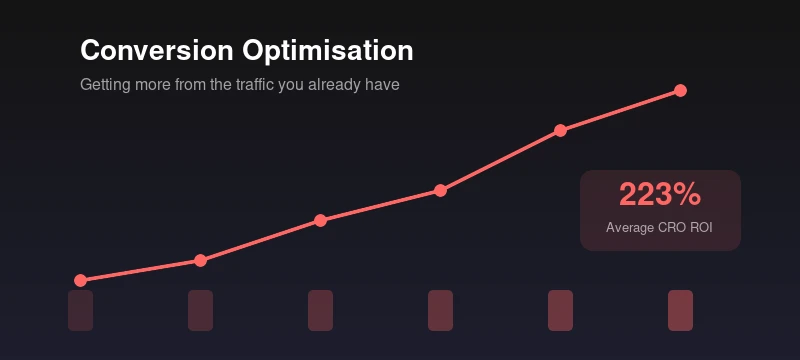
Companies using conversion optimisation tools and techniques see an average return on investment of 223%. That’s because even small improvements – a clearer call to action, a faster-loading page, a simpler form – can have a measurable impact on enquiry rates.
Where most websites lose visitors
Understanding where and why visitors leave without converting is the first step. In our experience working with SME websites, the most common issues tend to fall into a few key areas.
2.9%
Average website conversion rate across industries
Source: Unbounce 2023
7%
Conversion drop for every extra second of load time
Source: Portent
81%
Of users abandon a form after starting it
Source: Formstack
Page speed
This is one of the biggest and most overlooked factors. Research consistently shows that every additional second of page load time reduces conversions by around 7%. A site that loads in one second converts at roughly double the rate of one that takes five seconds. For a business generating enquiries through its website, that’s not a minor detail – it’s the difference between a pipeline that grows and one that stalls.
Unclear calls to action
Many SME websites have good content but don’t make it clear what the visitor should do next. If your call to action is buried at the bottom of a long page, or uses vague language like “Learn More”, visitors are far less likely to take the step you want them to. Effective calls to action are visible, specific, and positioned where they make sense in the visitor’s journey.
Forms that ask too much
Contact forms are often the final hurdle between interest and enquiry – and it’s where a surprising number of websites lose people. With 81% of users abandoning forms after starting them, reducing the number of fields to only what’s essential can have a dramatic effect. If you’re asking for a company name, job title, phone number, message, and reason for enquiry before someone can say hello, you’re creating unnecessary friction.
Weak trust signals
When someone visits your website for the first time, they’re making a quick judgement about whether to trust you. Client testimonials, case studies, recognisable logos, industry accreditations, and clear contact information all play a role. Without these, visitors may feel uncertain – and uncertain visitors don’t convert.
Poor mobile experience
Mobile now accounts for over half of all web traffic, yet many business websites still treat mobile as an afterthought. Buttons that are too small, text that’s hard to read, and forms that don’t work properly on a phone all reduce the chance of conversion. A website that looks polished on desktop but frustrates on mobile is losing enquiries every day.
Practical steps you can take
The good news is that conversion optimisation doesn’t require a complete website rebuild. Many of the most effective improvements are relatively straightforward to implement and can start showing results quickly.
| Common Issue | Quick Win |
|---|---|
| Slow page load (3+ seconds) | Optimise images, enable caching, reduce unused plugins |
| Generic CTA (“Learn More”) | Use specific, action-oriented language (“Get a Free Quote”, “Book a Call”) |
| Long contact form (8+ fields) | Reduce to 3–5 essential fields – name, email, message |
| No social proof visible | Add testimonials and client logos near key conversion points |
| CTA only at page bottom | Add a clear CTA above the fold and repeat after key sections |
| Mobile forms hard to use | Test all forms on mobile – ensure buttons and fields are thumb-friendly |
1. Audit your key pages
Start with the pages that matter most – your homepage, services pages, and contact page. Look at them from a visitor’s perspective: is it immediately clear what you do, who you help, and how to get in touch? Tools like Google Analytics can show you where visitors are dropping off, giving you a clear starting point.
2. Simplify the path to enquiry
Remove unnecessary steps between a visitor arriving on your site and making contact. That might mean adding a prominent call to action higher up the page, simplifying your contact form, or making your phone number more visible. Every click or scroll that isn’t needed is an opportunity for someone to leave.
3. Strengthen your trust signals
Review your website through the eyes of someone who has never heard of your business. Do you have client testimonials displayed prominently? Are your case studies easy to find? Is it clear how long you’ve been in business and what kind of clients you work with? These details may feel secondary, but they directly influence whether a visitor feels confident enough to make contact.
4. Improve Page speed
Use Google’s free PageSpeed Insights tool to check how your key pages perform. Common fixes include optimising image sizes, enabling browser caching, reducing the number of plugins, and ensuring your hosting is up to the task. Even modest improvements in load time can translate to measurably better conversion rates.
5. Test and measure
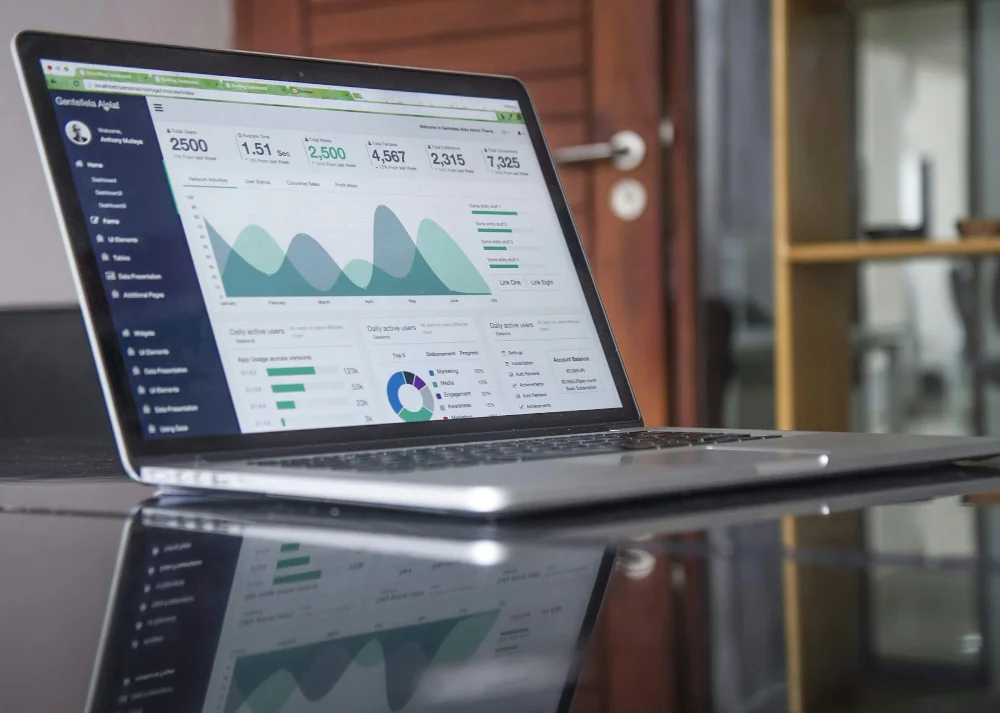
Conversion optimisation is not a one-off task. The most effective approach is to make changes, measure the results, and refine over time. Set up goal tracking in Google Analytics so you can see exactly how many visitors are completing your desired action – and whether that number improves as you make changes.
Your conversion optimisation checklist
- Run Google PageSpeed Insights on your homepage and key service pages
- Check your contact form – can someone get in touch in under 30 seconds?
- Review your calls to action – are they visible, specific, and above the fold?
- Ensure testimonials or case studies appear on your most-visited pages
- Test your entire enquiry journey on a mobile phone – start to finish
- Set up Google Analytics goal tracking for form submissions and phone clicks
- Remove unnecessary distractions – pop-ups, sliders, competing CTAs
Making it count in 2026
In an environment where every pound of marketing spend is under scrutiny, conversion optimisation represents one of the most efficient investments a business can make. It doesn’t require a large budget, it builds on what you already have, and the improvements compound over time.
The average website converts at around 2–3%. That means 97 out of every 100 visitors leave without taking action. Even moving that number by one percentage point can have a meaningful impact on your pipeline – particularly for service-based businesses where each new enquiry carries real value.
At 4D Digital we regularly help clients improve their website performance through practical, data-led conversion optimisation. Whether it’s a focused review of your key pages or a broader strategy to improve enquiry rates, we can help you get more from the website you already have. Get in touch if you’d like to talk it through.